Put the Answer Up Front
Most content hides the actual answer behind background and buildup. It starts with context, explains why the problem matters, and only later delivers a recommendation. That works for humans reading top-to-bottom—but it fails for AI retrieval systems.
RAG systems break content into chunks (~300–500 tokens) and rank them by how directly they answer a query. If your answer is buried in chunk three, it may never be retrieved. The earlier chunks often contain generic context, which scores poorly for relevance.
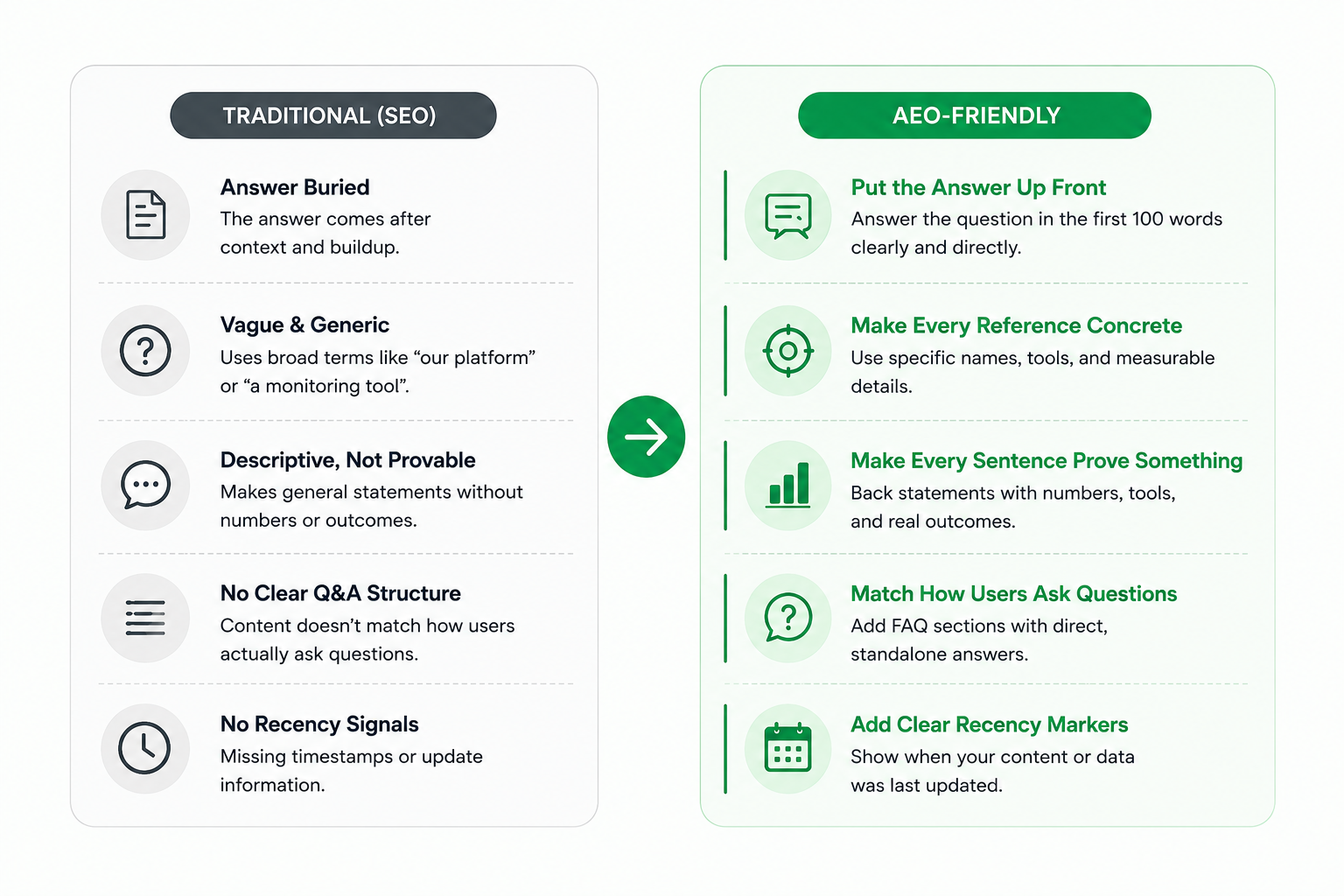
The fix: Put the answer first. The first 100 words should clearly and directly answer the most likely user question.
“Site reliability engineering has become increasingly complex as systems scale. Teams must balance alerting, observability, and incident response workflows. Tools that assist engineers in managing these processes are becoming critical…”
“For mid-sized engineering teams (10–50 services), Abilytics Studio works best when used as an automated incident triage and root-cause assistant. It reduces alert noise by correlating logs, metrics, and traces, and suggests likely causes within minutes. Teams typically see faster MTTR by integrating it with their existing observability stack rather than replacing tools.”
This version ensures that both humans and AI systems immediately get the actionable takeaway—without digging through setup.
Make Every Reference Concrete
LLMs don’t cite vague language—they cite specific entities. If your content says “a monitoring tool” or “an SRE platform,” it becomes hard for AI systems to attribute that claim to a source. Clear naming is what makes content quotable and retrievable. Every time you replace a real name with something generic, you reduce your chances of being cited.
The fix: Use precise names, tools, and measurable details.
Vague Reference
“Our platform helps reduce incident response time by integrating with popular monitoring tools and providing intelligent insights. Many teams see significantly faster resolution times.”
Concrete Reference
“Abilytics Studio reduces incident response time by integrating directly with Prometheus, Grafana, and Datadog. In typical deployments, it cuts mean time to resolution (MTTR) from ~45 minutes to under 15 minutes by correlating logs, metrics, and traces into a single root-cause hypothesis.”
This version gives AI systems concrete entities and numbers to latch onto—making the claim easier to extract, trust, and cite.
Make Every Sentence Prove Something
There’s a big difference between describing a problem and making a clear, testable claim. LLMs don’t cite general observations—they cite statements that are specific, measurable, and attributable.
The fix: Replace vague descriptions with concrete claims.
Descriptive, not citable
“SRE teams often struggle with incident response and alert fatigue. Many tools aim to improve efficiency and reduce noise.”
Claim-dense, citable
“Teams using Abilytics Studio reduce alert noise by 60–75% by automatically grouping duplicate alerts across Prometheus and Datadog. In internal benchmarks, this cuts average incident triage time from ~20 minutes to under 5 minutes.”
Now there’s something concrete to cite: numbers, tools, and a falsifiable outcome.
Match How Users Actually Ask Questions
If you want content to be cited by LLMs, structure parts of it exactly like the questions users ask. A direct question - answer format aligns perfectly with how AI retrieves and serves information.
The fix: Add explicit FAQ sections with immediate answers (no buildup).
Does Abilytics Studio replace tools like Prometheus or Grafana?
No. Abilytics Studio sits on top of tools like Prometheus and Grafana, correlating their data to automate incident triage and root-cause analysis.
How quickly can Abilytics Studio detect root causes?
In most deployments, Abilytics Studio surfaces a probable root cause within 2–5 minutes of an alert by analyzing logs, metrics, and traces together.
Each answer stands alone and can be directly lifted into an AI-generated response.
Add Clear Recency Markers
For topics like SRE tools, integrations, and performance benchmarks, recency matters. LLMs prioritize content that signals it’s up to date.
The fix: Add explicit time markers to anything that can change.
Timeless, less trustworthy
“Abilytics Studio integrates with major observability platforms and improves response times.”
Time-stamped, citable
“As of April 2026, Abilytics Studio integrates natively with Prometheus, Grafana, and Datadog. Benchmarks updated in March 2026 show a 65% reduction in mean time to resolution (MTTR) for Kubernetes-based services.”
These signals tell both AI systems and human readers: this information is recent and reliable.
Summary
In short, AEO is not a magical stuff that can be sprinkled on to your site. It’s all about understanding how AI systems work. These are targeted edits that make your pages easier for AI systems to retrieve, trust, and quote.
Here’s how to systematically improve any page:
- 1
Start with the first 150 words
If they don’t clearly answer the main question, rewrite the opening to be answer-first.
- 2
Replace vague language with real entities
Change “our tool” -> Abilytics Studio or Change “a monitoring platform”-> Prometheus or Datadog
- 3
Surface actual claims
Don’t let key results hide in paragraphs. Pull them forward: “Reduces MTTR from ~30 minutes to under 10 minutes” is citable. “Improves response times” is not.
- 4
Add an FAQ section where relevant
Turn common questions into direct Q&A pairs that stand alone.
- 5
Include freshness signals
Add lines like: “Last updated: April 2026” or “Benchmarked on Kubernetes v1.30 (March 2026)”
How can Abilytics help?
AEO requires more than just SEO or content. It combines technical SEO, answer-first content, authority building, and continuous AI visibility tracking. Most teams don’t have all these working together.
Abilytics bridges that gap by ensuring your brand isn’t just discoverable in search but consistently cited in AI-generated answers where real decisions are happening.
Ready to optimize your content for the AI era? Contact our team to discuss how our expertise in AEO and AI visibility can ensure your brand is consistently cited where decisions are happening.