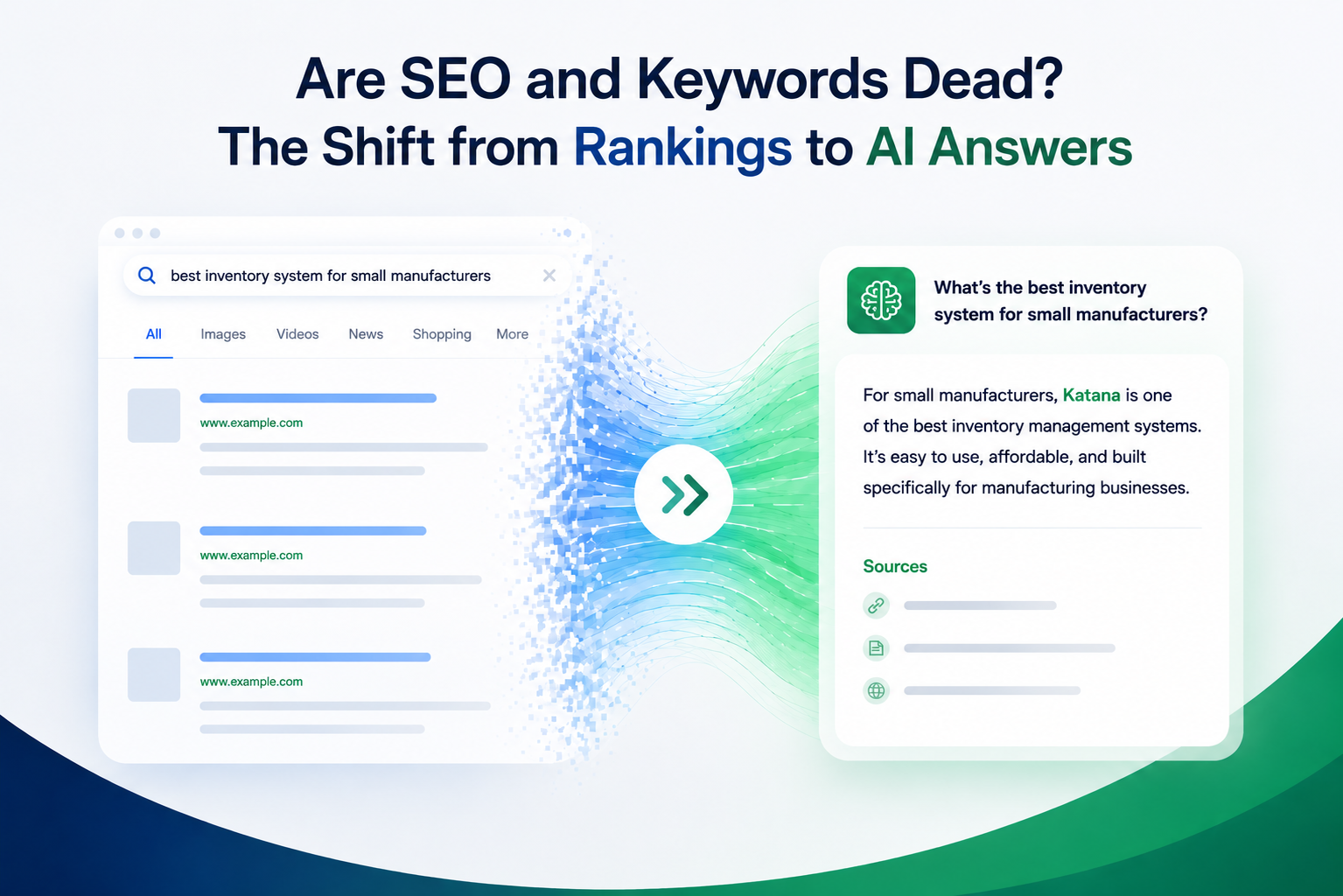
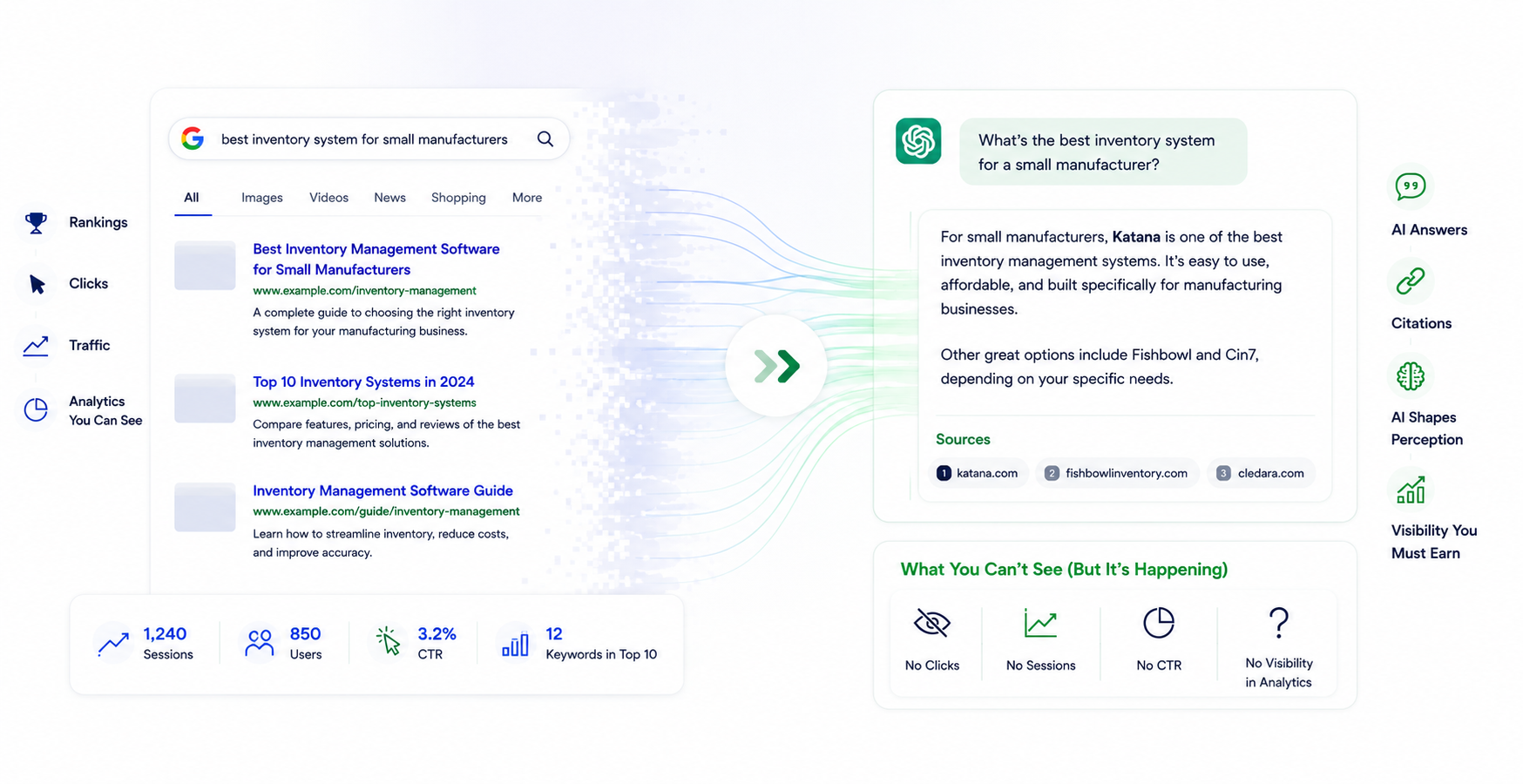
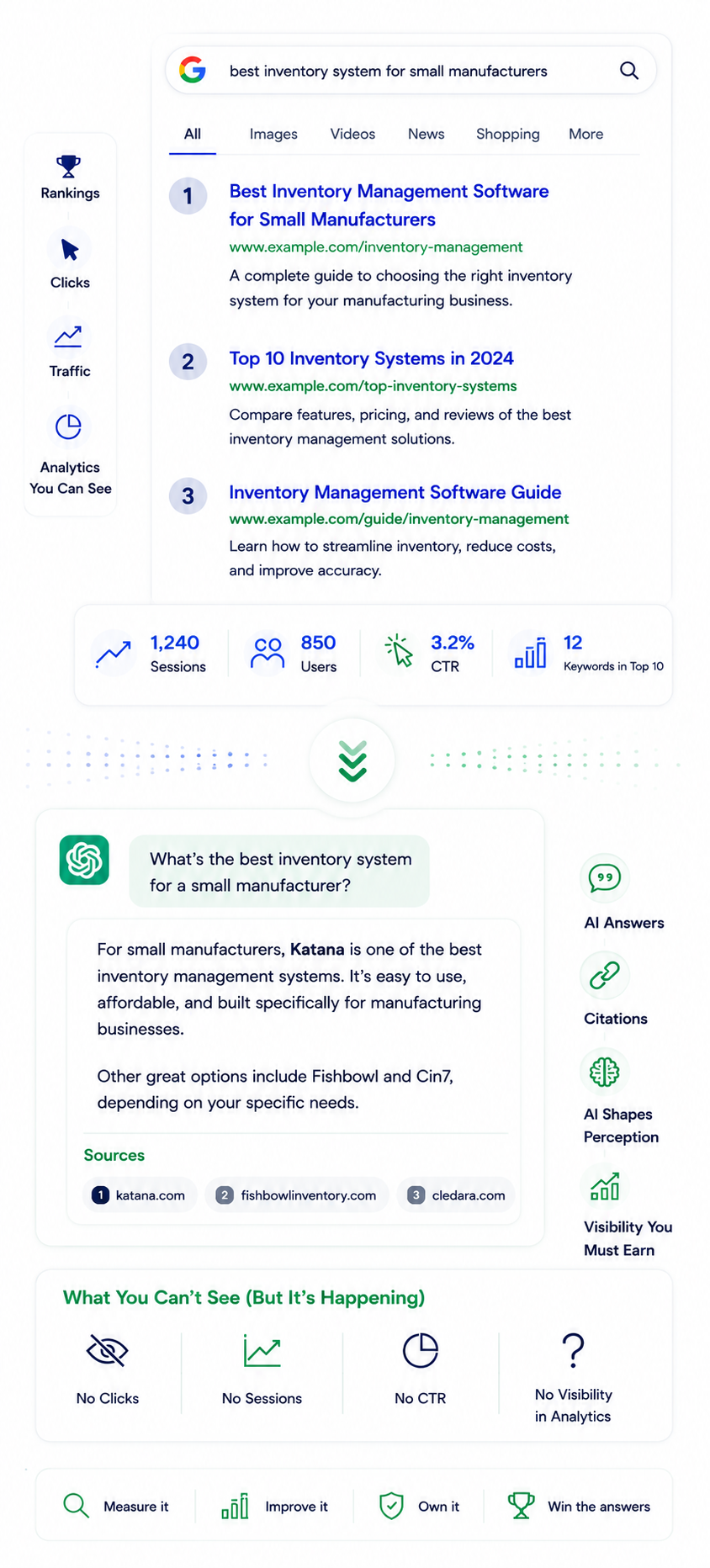
For years, traffic and keyword rankings worked because discovery followed a simple path: search -> ranked links -> clicks -> analytics. If you ranked well, you got clicks. If you got clicks, you were visible. That loop made keywords a reliable proxy.
That loop is broken.
Keywords still matter. You need to be indexed, crawlable, and topically relevant. But they no longer tell you whether your brand shows up where decisions are increasingly made inside AI-generated answers.
What actually changed?
When someone asks an AI tool, “What’s the best inventory system for a small manufacturer?” or “How do I reduce churn in a subscription business?”, they don’t get a list of links anymore. They get a direct answer with sources.
Your brand is either included in that answer, or it isn’t. No click happens. No session is recorded. Your analytics look identical whether you were cited 10,000 times today or not at all. The interaction happened—you just can’t see it.
The real problem: your visibility signal is gone
Traffic was never the goal. It was a proxy for something more important: being present and trusted at the moment someone makes a decision. That proxy worked because discovery required a click. AI removes that requirement. Now:
- The user still gets an answer
- They still form an opinion
- Your brand either shapes that opinion or doesn’t
But none of it shows up in your dashboards. Rankings can look strong while visibility disappears. It’s now possible to be Rank #1 for key terms, maintain steady traffic, hit all your SEO KPIs …and still be completely absent from AI-generated answers in your category.
At the same time, a smaller site with no strong SEO metrics can show up consistently, simply because it answers questions clearly, specifically, and directly. AI systems don’t rank pages. They extract answers.
The new signal: citation rate
AI systems using retrieval (RAG) don’t ask, “Does this page rank for a keyword?” Instead they ask, “Does this passage directly answer this question?”
That shift changes everything.
The metric that matters now is the citation rate:
- 1How often your brand appears in AI-generated answers about your target category
- 2What claims are attributed to you
- 3In what contexts do you appear
- 4How often competitors show up instead
This is your real visibility layer and most teams aren’t measuring it.
To measure it you need to be:
- Running real user queries in AI tools
- Auditing responses
- Tracking which brands are cited and why
- Monitoring changes over time
It also requires a different way of writing:
- · Lead with the answer
- · Make specific, testable claims
- · Use clear, named entities
- · Put the key insight in the first 100–150 words
This isn’t new; it’s just disciplined, high-signal writing. The kind AI systems are trained to prioritize because they are genuinely useful.
The measurement gap is now the strategy gap. Right now, the advantage comes from measuring what others ignore.
Citation rate is observable:
- ✓You can run the same queries your customers ask
- ✓You can analyze AI responses
- ✓You can track attribution trends over time
Teams doing this have a clear map of their real visibility. Everyone else is relying on tools built for a model that no longer reflects how discovery works.
Why this is more dangerous than it looks
Traffic isn’t going away. Keywords still matter. Search is still part of how many AI systems retrieve information. But those are baseline requirements, not indicators of success.
Traffic tells you who clicked. It tells you nothing about the growing number of people who asked an AI and decided without ever visiting your site.
In traditional SEO, loss was visible as rankings dropped, traffic declined, leads slowed.
Now, you can lose all AI-driven visibility while your metrics stay flat or even improve.
The loss is silent.
The companies at risk aren’t ignoring SEO. They’re executing it well, while missing the shift entirely.
How can Abilytics help?
A team focused only on SEO will optimize for rankings but miss how answers are formed. A team focused only on content may write well but lack the technical and distribution foundation needed for retrieval and trust.
A modern AEO approach requires all of it to work together continuously. That’s what Abilytics is able to bring.
Ready to measure your real visibility in the AI era? Contact our team to explore how an integrated AEO strategy can protect your brand from the silent loss of discovery.