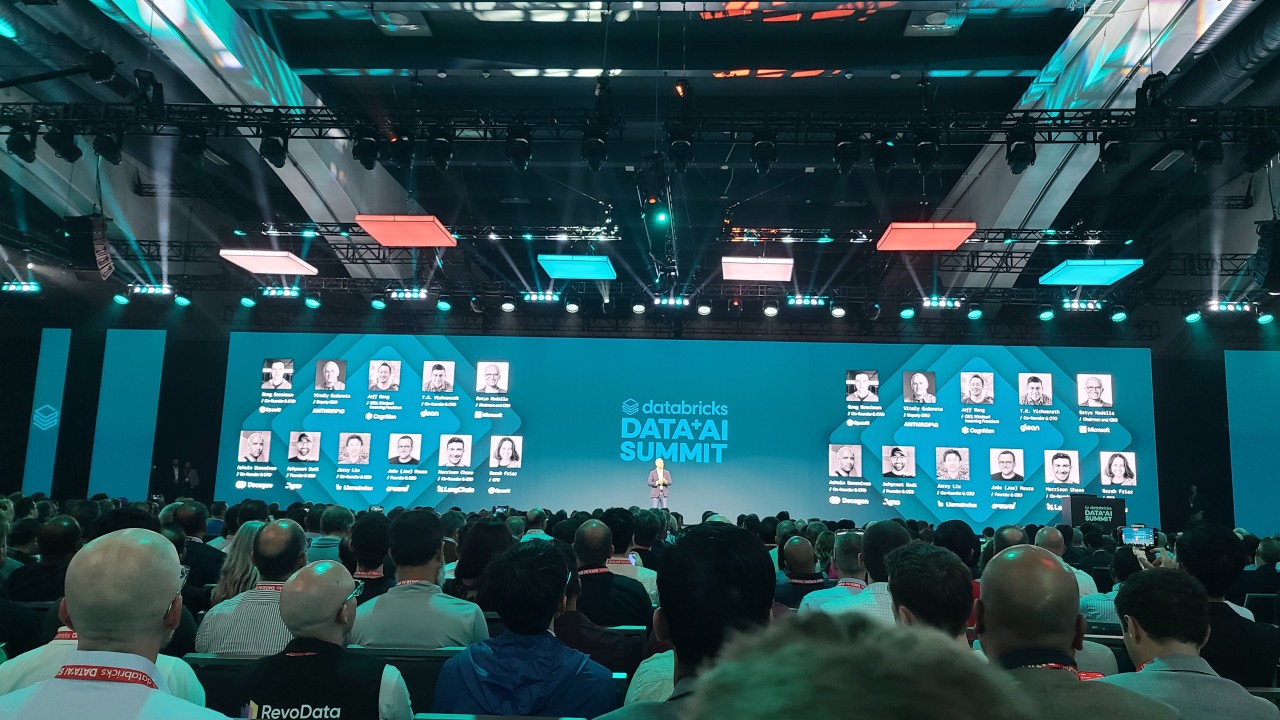
Databricks used its 2026 Data + AI Summit, roughly 30,000 attendees at Moscone Center, June 15–18, to make a point its own CEO said out loud: AI has a context problem, not an intelligence problem.
That framing matters more than any single product name. Genie Ontology, Unity AI Gateway, Agent Bricks, Omnigent, Databricks Sandbox, LTAP, Lakehouse//RT, CustomerLake and Lakewatch aren't seven or eight unrelated launches. Together they describe a platform trying to become the control plane for agentic enterprises — one layer governing context, identity, cost, execution and security so AI agents can act without an enterprise losing track of what they're doing.
That's a useful ambition. It is not a shopping list. Here are the eight decisions it actually creates for the people who have to make the architecture work.
The Summit in One Minute
Context layer
Genie One (now GA), Genie Ontology, Genie Code, Genie ZeroOps and Genie App Builder connect enterprise data to AI coworkers and automate the operational grind of running data and ML pipelines.
Semantics, formalized
Unity Catalog added Business Glossary, Domains and Metrics — governed, reusable definitions of business terms and KPIs that Genie Ontology draws directly.
Governance at runtime
Unity AI Gateway now governs models, agents, MCP servers, tools, cost and routing — not just who can see what, but what agents are allowed to do while running.
Execution
Agent Bricks and Omnigent cover building, evaluating and orchestrating agents; Databricks Sandbox gives agents isolated VMs to execute code without touching production directly.
Data architecture
LTAP proposes one copy of lake storage serving both transactional and analytical workloads; Lakehouse//RT (powered by a new query engine, Reyden) brings millisecond-scale serving into beta.
Applications and security
CustomerLake moves Databricks into customer data platform territory. Lakewatch, an agentic SIEM, and the announced acquisition of Panther push Databricks — for the third time this year, after Antimatter and SiftD.ai — deeper into security software.
Enterprises should read that list once, then stop treating it as a checklist. The real question is what changes about how technology gets designed, funded and governed.
Who Owns Enterprise Context?
Most enterprise AI failures get blamed on the model. Many are actually context failures — a model that understands accounting in general but not how this company defines "adjusted margin," or a term like "active opportunity" that means three different things to sales, finance and legal.
Genie Ontology is Databricks' answer: a self-improving context layer that extracts business meaning from tables, dashboards, queries, and connected apps like Jira, Slack and SharePoint. Unity Catalog's new Business Glossary, Domains and Metrics feed it directly, the idea being that a KPI gets defined and certified once, then called identically by every dashboard, notebook and agent, instead of drifting between teams.
That's a real improvement over the status quo. A tool that automatically extracts meaning from existing systems will just as efficiently extract inconsistency, if no one is accountable for the source data.
The new risk is context debt: business definitions, ownership rules and data relationships that are inconsistent or outdated. A human analyst who hits a strange number can ask a colleague. An agent will often just execute against it, repeatedly, across every connected system. Context debt then becomes decision debt.
What to establish: a context contract per agent-enabled workflow: authoritative sources, approved definitions, data ownership, freshness requirements, quality thresholds, and explicit behavior when context is missing.
Pair it with context SLOs: percentage of agent decisions using an authoritative, fresh source; unresolved semantic conflicts; definition changes that haven't been regression-tested. Treat the semantic layer as production infrastructure.
How Much Autonomy Does Each Agent Earn?
The wrong governance question is "should we allow autonomous agents?" The workable one is: what degree of autonomy is appropriate for this workflow, under these conditions, within this blast radius?
Unity AI Gateway's expanded scope — contextual policies, hard spending caps, model routing, tracing, tool invocation controls — gives enterprises the levers. Applying identical controls to every agent either over-restricts low-risk assistants or leaves high-autonomy systems dangerously under-governed.
Introduce an autonomy budget, the maximum impact an agent can create without additional approval: maximum financial value, records it may change, systems it may touch, external communications it may send etc. A read-only knowledge agent can have broad document access and zero write permission. A financial agent can propose a payment while execution stays gated behind policy and segregation of duties. Autonomy should be earned through evidence in production.
What's the New Unit of Architecture?
Most AI architecture conversations still center on the model. That's increasingly the wrong frame. A production agentic workflow typically threads together multiple models, specialist agents, retrieval services, enterprise APIs, MCP servers, operational databases, human approvals, policy engines and retry logic. The workflow is the actual unit of architecture now.
Agent Bricks and Omnigent reflect this: Databricks itself frames the agent loop as a small fraction of production effort, with deployment, evaluation, monitoring, context, security and cost making up the rest. Databricks Sandbox is the clearest evidence of this shift toward workflow-level thinking, which governs where and how the agent's code runs.
An enterprise should be able to trace, end to end: which identity initiated a workflow, which agent accepted it, what context it retrieved, which models, tools, policy it used etc. Model monitoring alone answers none of that. It requires workflow tracing that crosses model, data, API and application boundaries, which is exactly the gap Unity AI Gateway and Sandbox are trying to close, and exactly why neither one alone is sufficient.
How Is Agent Economics Actually Measured?
Unity AI Gateway adds cross provider cost visibility, attribution and hard spending limits. A cheap workflow that's wrong half the time can cost more than an expensive one that's reliable.
Move the metric from cost per token to cost per successful outcome: cost per resolved incident, per completed customer request, per accepted change, per accurate forecast, per approved transaction. The calculation must include retrieval and tool costs, repeated agent loops, failed runs, human review, exception handling and downstream corrections, not just inference spend.
Gartner's often-cited prediction that more than 40% of agentic AI projects will be cancelled by the end of 2027 is worth using carefully: it was published in June 2025, and much of the coverage repeating it in 2026 presents it as new research when it isn't. That doesn't make the underlying warning wrong, Gartner's own 2026 Hype Cycle still places agentic AI at the Peak of Inflated Expectations, with roughly 17% of organizations having deployed agents against 60%+ planning within two years. That gap between intent and deployment is exactly where cancellations come from. The lesson: AI FinOps belongs inside product management and reliability engineering, not on a separate billing dashboard, and any stat you cite to justify governance spend is worth checking for its actual publication date.
Where Does the Business Genuinely Need Live Truth?
LTAP and Lakehouse//RT challenge the old separation between transactional, analytical, and real-time systems. LTAP proposes a single copy of lake storage serving both workload types (announced as coming, not yet shipped). Lakehouse//RT, running on a new engine called Reyden, is in beta and aimed at millisecond-scale serving directly against governed lakehouse data, no separate serving copy required.
Real-time architecture earns its cost when delayed information changes the decision: fraud detection, dynamic pricing, payment authorization, security response. Plenty of workflows are fine on hourly or daily data. The discipline isn't "make everything real time" — it's defining the maximum acceptable decision latency per workflow.
What's the Acceptable Agent Blast Radius?
Traditional applications perform predetermined actions through known interfaces. Agents select tools, generate code, interpret loose instructions, and change their own sequence of actions mid-task. That makes blast radius — everything that could be affected if an agent misreads its objective, uses stale context, picks the wrong tool, or loops on a retry — a first-class architecture concern, not an afterthought.
Databricks Sandbox is a direct, concrete response to this: isolated VMs where agents execute code against governed data without touching production systems directly. It's also not sufficient on its own — sandboxing constrains where code runs, not what happens when an agent is deliberately targeted or manipulated mid-workflow, which is a different problem than the one Sandbox solves.
Treat production agents as distributed systems with nondeterministic components: define reliability objectives, safe failure states, circuit breakers, retry limits, rollback procedures, human escalation paths and kill switches. The agent shouldn't just know how to complete the task — it should know when it's no longer safe to continue.
Is Your Governance Team and Your Security Team Solving the Same Problem, Separately?
Databricks didn't just add AI governance this year — it made its third security acquisition in twelve months. In March it launched lakewatch, an agentic SIEM unifying security, IT and business data on the lakehouse. In June, at the summit itself, it announced intent to acquire Panther, an AI-native SOC platform used by companies including Anthropic, on top of earlier acquisitions of Antimatter and SiftD.ai. Databricks is explicitly positioning "security lakehouse" as a new category meant to displace legacy SIEM.
Put next to Unity AI Gateway, that's not a coincidence. Governance (what an agent is allowed to do) and security operations (detecting when an agent, or an attacker using agents, does something it shouldn't) are being built on the same data foundation, by the same vendor. For most enterprises today, those are still two different teams, and two different tools that don't share a data model. That gap is itself a blast-radius problem.
One security vendor reviewing the Panther acquisition made a fair distinction worth keeping in mind: detecting an AI-driven attack after the fact and enforcing a policy on an AI decision in real time are architecturally different problems, and consolidating both onto one lakehouse doesn't automatically make them the same capability.
What to establish: before evaluating any vendor's "unified" governance-and-security story, map who currently owns agent policy decisions versus who owns agent-related incident response in your organization, and whether either team can see the other's traces today. If the answer is no, that's the actual gap to close — independent of which platform you buy.
A Practical 90-Day Response
Pick one workflow with measurable value, bounded risk, and a named business owner. Document the outcome, current cost and performance, required data, approved definitions, decision latency, human approval requirements, autonomy limit, and expected failure modes. Output: a context contract and an initial autonomy budget.
Build the control and observability foundation — agent and tool registration, unique workload identity, runtime permissions, cost thresholds, trace collection, evaluation datasets, context SLOs, and escalation/rollback procedures. This needs platform engineering, data, security and FinOps in the same room, not sequential handoffs.
Run the workflow in production with a limited user population, restricted write access, explicit spending caps, human approval for material actions, end-to-end traces, and adversarial testing. Then make one of three calls: scale it, redesign it, or stop it. Stopping a workflow that isn't earning its keep is a successful governance outcome, not a failed project.
The Abilytics Perspective
The lakehouse is evolving from a system of analysis into a potential system of context, decision and execution. But no enterprise gets a working control plane by installing one gateway, one ontology or one agent framework. It's built by connecting governed data, business semantics, real-time architecture, agent identity, runtime policy, engineering reliability, cost accountability and human decision rights — and by making sure the teams governing agents and the teams securing them are reading the same traces.
That's implementation work, not a slide. Abilytics works with enterprises on the parts of this that don't show up in a keynote: scalable lakehouse architecture, real-time pipelines, Unity Catalog governance done properly the first time, and production AI engineering built on Databricks-native tooling.
The right response to this summit is in deciding where trusted context, controlled autonomy, real-time execution and unified security create measurable advantage for your business — then engineering that one workflow with the same discipline you'd apply to any other mission-critical system.
Frequently Asked Questions
Q:What was the main theme of Databricks Data + AI Summit 2026?
Moving enterprise AI from demos into production operations, built around a shared lakehouse foundation for data, context, agents, governance, real-time serving and — as of this summit — security operations.
Q:What is an agentic enterprise control plane?
The architectural layer coordinates context, identity, permissions, tools, policy, cost, and observability so enterprise agents can operate safely. It's broader than an agent-development platform because it must govern the full workflow across systems that won't all live on one vendor.
Q:Why did Databricks acquire a SIEM company at a data platform conference?
Because Databricks is betting that AI governance and security operations are converging onto the same data layer. It launched lakewatch, an agentic SIEM, in March 2026, then announced intent to acquire Panther, an AI-native SOC platform, at the summit itself — its third security acquisition in a year. Whether that consolidation actually closes the gap between governance teams and security teams depends on execution, not the acquisition alone.
Q:Does LTAP mean enterprises should replace their operational databases now?
Not yet — it was announced as coming, not shipped. It's a real architecture direction for reducing data copies and CDC pipelines, but validate performance, workload isolation, recovery, and portability against your own requirements before making migration decisions.
Q:Should every enterprise treat the Gartner "40% of agentic AI projects cancelled by 2027" statistic as urgent new data?
Treat the underlying warning seriously but check the date — Gartner published it in June 2025, and it's frequently recirculated in 2026 coverage as if it were fresh. The structural gap it points to (17% of organizations deployed vs. 60%+ planning within two years) is current and worth planning around.